AuraQ has vast experience helping organisations find the gaps that can be filled to enhance their business. This could be to improve efficiency, integrate legacy systems or deliver new portals and strategic applications to create competitive advantage. Contact us to request a free, no obligation Gap Analysis.





AI-powered low-code: The next phase of Mendix development
Artificial Intelligence (AI) has become an important part of low-code applications for both end users and developers. While there has been a predominant focus on using AI tools – such as forecasting and chatbots – as a direct product for end users, there are frequent advancements in using AI during the development process. These advances can be seen first-hand within the Mendix ecosystem, where new AI tools are being built to support development.
Since 2018, Mendix has been using AI to assist with development. With the release of Mendix 10 in 2023, the collaboration between Mendix and AI has grown exponentially and continuously into the release of Mendix 11 in 2025. The power of AI has been harnessed through tools such as translation generation, machine learning deployment, and chatbot integration. The continuous development of these, and an ever-growing list of new AI tools, has led to a major shift in application development over the past few years.
This blog will explore some of the key game-changers that low-code and AI collaboration through Mendix can bring. With the explosive development of new AI tools, it is important to note that this isn’t an exhaustive list. To check for updates on the range of AI tools within Mendix, be sure to check the release notes for recent releases of Mendix.
Assisted development
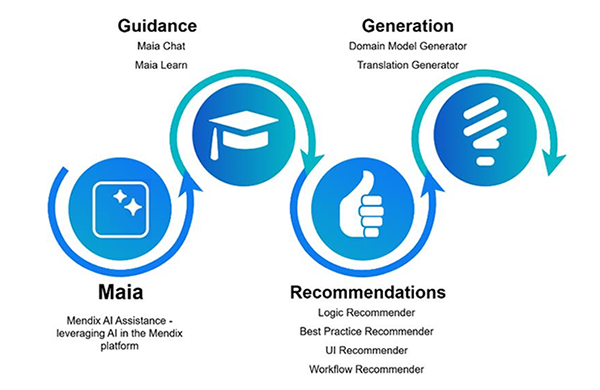
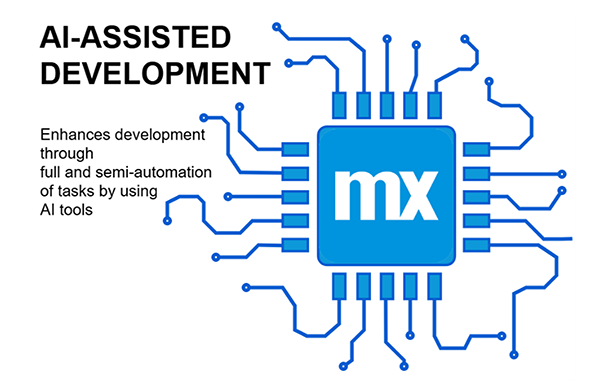
AI assisted development aims to use AI technology to enhance the development process by automating repetitive tasks and recommending code solutions. With the release of Mendix 10.12 in the summer of 2024, the integration of the Mendix AI Assistant (Maia) aims to help developers with building applications. This tool has seen rapid growth in capabilities, which was seen with the release of Maia Learn at the end of 2024 to help developers get up to speed with core concepts of low-code and Mendix Studio Pro.
A key feature of Maia is Maia Chat (formerly known as MendixChat). This chatbot uses Maia in Studio Pro to allow users to ask development questions. As this chatbot is trained on Mendix data, its answers are fine-tuned to support Mendix development. This provides a new source of information that can be useful to new developers in the Mendix environment who may find it daunting to search through documentation for answers.
Maia has also improved existing tools in the Mendix platform. The Logic Bot in Mendix has been around since 2019, and its capabilities have been continuously improved. Initially, the bot recommended the next best actions in microflow logic flow, but thanks to Maia, it has expanded its capabilities to also predict the parameters of a microflow, configure the best activities in workflows, and recommend new widgets to use on your page. These improvements in the bot’s ability to better understand project contexts demonstrates an ongoing goal to accelerate development by recommending the best next steps in the logic. What started with recommending logic actions in 2018, has now expanded to recommending functionality and design across your application in 2025.
Going into 2026, Maia has further expanded its features to generate overview pages and domain models. This can be done through the chat functionality in Maia, similar to querying other chat models such as GPT and Gemini. The capabilities of Maia are constantly evolving alongside Mendix. To see an exhaustive list of its features, keep up to date with the Maia Make documentation.
Automating tasks
Automating mundane and repetitive tasks is where AI can significantly speed up development. Previously, translating text within your application was a labour-intensive process that required either importing translated text or manually typing the translation. This task has now been streamlined with the Maia Translation Generator, whereby system text can be translated by adding a new language to your application. This automation of translation ensures that your application can be accessible globally by providing shorter development time to provide new languages to your end users. Additionally, by removing manual efforts required to translate all project text, there is less risk of human error in translation, improving accuracy and consistency throughout your projects.
Through Maia, Mendix is promoting the use of AI automation in project planning. With the release of Mendix 11.8 in 2026, Maia can now be used to generate initial user stories and the foundational stages of application logic based on these stories. This aims to support the initial project planning stage, enabling developers to build on these generated user stories. This can also be a useful tool at the ideation stage of projects, demonstrating what is feasible in the early stages of the project lifecycle.
Mendix has had a partnership with AWS for nearly over a decade. This partnership is a crucial step in combining low-code with generative AI (AI that can create content). Examples of the power of generative AI include using AWS Bedrock to convert an SQL file into a Mendix domain model and sending a request to Bedrock to generate sample data for applications. These examples demonstrate the potential for accelerated development by streamlining tasks that would typically take longer due to manual data entry. Moreover, AWS services such as Bedrock allow you to customise models with security in mind by enabling encryption and private connections through their key management and private link services. This demonstrates a robust, security-conscious environment in which connections to AWS can be used to achieve generative AI in Mendix.
AI-augmented applications
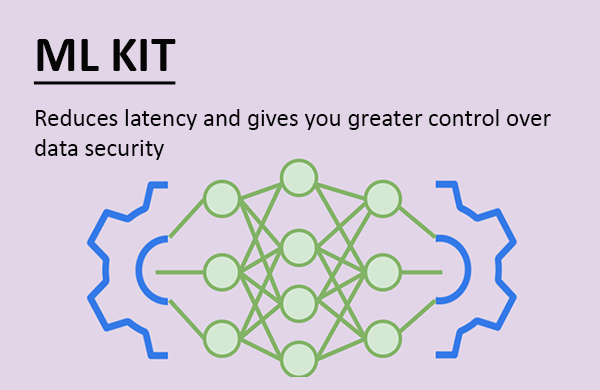
AI-augmented applications are those where AI is used to improve the user experience. The main ways of doing this in Mendix are through REST APIs and the Machine Learning kit (ML Kit). The ML Kit gives you greater control over your AI-augmented applications. By deploying your own ML model, you have a greater control over your application data, reducing data security risks that may arise from accessing third-party AI services. Additionally, deploying your own ML model can reduce cost and latency because the model is contained within your own environment rather than calling to a third-party hosted service.
The ML Kit allows developers to integrate their own machine learning models into applications. It is important to note that ML Kit is more beneficial for smaller models with it taking up application memory to run. Attempting to run large models on small environments using ML Kit will likely cause memory issues, having an adverse impact on user experience. To learn more about the ML Kit, check out or blog that dives deeper into using machine learning in Mendix.
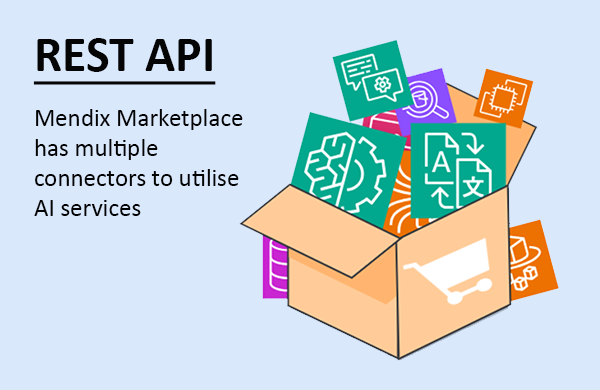
Larger models, such as ChatGPT, can be utilised through API calls. With these large models allowing you to fine-tune responses to meet your business needs, integrating them into Mendix allows you to gain further insights into your business data [5]. In addition, the Mendix Marketplace provides various connectors to AI services that can extend the capabilities of your applications. Notably, AWS connectors are available that can extract text from documents, analyse videos, and provide text-to-speech capabilities. By using API calls to access AI services, there is less consideration about the development and maintenance of these underlying AI models. As a result, you can develop AI-enabled applications without a deep understanding of AI model development.
Monitoring and maintaining high standards within AI-augmented applications is important to establish trust in the AI outputs provided to end users. To assist in managing the lifecycle of AI in applications, the Agent Commons module can be imported into Mendix projects. This module allows you to explicitly state which functionalities AI will be assisting or automating within applications. Furthermore, its agent versioning helps in transparency and accountability where changes in AI functionalities can be tracked. This is an important step in AI-augmentation which may be overlooked but is required to improve security and regulatory compliance.
As seen with Maia Chat and ChatGPT, chatbots are a popular use of generative AI. There are many opportunities to harness this type of tool in your own application, especially with starter applications provided by Mendix to assist in interacting with external models from OpenAI or AWS. Chatbots can be used openly by giving end users a text input to interact with the model like they would with ChatGPT. Alternatively, you can use these models in your microflow logic to perform specific tasks which are then formatted before returning results to the end user. This highlights the power of generative AI and Mendix, where the results can be beneficial to end users without those users directly interacting the chatbots, giving developers control over how AI tools are used in their applications.
Conclusion
Seeing the advances in low-code and AI collaboration can be exciting and lead to ever-growing opportunities. However, it is important to consider whether your use case requires AI integration; trying to shoehorn AI into your application can lead to less desirable outcomes such as resource inefficiency and mismanagement of application data. It is therefore important to consider how, if at all, AI will improve the application lifecycle for your projects.
While it is becoming easier to implement AI into applications, keeping expectations realistic is critical to increasing the chances of success. This is because 85% of AI projects fail, likely due to excessive expectations and a lack of behavioural change. Throughout this blog, we’ve seen a vast set of AI tools that are now available for use within Mendix. The best way to manage expectations is to try out the tools for yourself. This real-time learning of the tools is the best way to better understand the capabilities and limitations of AI in development and how it can improve your own development lifecycle.
AI collaboration has come a long way since the announcement of MxAssist in 2018. As new Mendix versions are released, low-code AI capabilities are likely to increase and improve in quality. So, as development becomes more intertwined with these AI tools, it is important to balance the excitement with assessing the suitability and risks of using these tools on a project-by-project basis to ensure maximum benefit.
Related Blogs



Drag