From Idea to MVP: How AI is Changing Software Discovery


Digital transformation projects can lose momentum before even the first line of code is written. The gap between having an idea and being ready to build it can take weeks or even months, as conversations are turned into requirements, requirements into specifications, and specifications into something a development team can act on.
During that time, stakeholders who were energised at the start can become frustrated waiting for documentation. IT teams inherit requirements they did not help shape. Delivery partners receive specifications written in business language that need translating. By the time everyone agrees on what is actually being built, valuable time and budget have already been spent and the appetite for change can start to disappear.
The Problem with Traditional Discovery
Traditional discovery is slow by design. A series of meetings produces notes. Those notes get turned into documents. Those documents get reviewed either by business analysts or, in many cases, business stakeholders who do not have the bandwidth to devote the time needed to interpret and translate those notes into something technical teams can act on.
The problem is that documentation can only take an idea so far. Business stakeholders may understand the problem they need to solve, but not how to describe it in technical terms. IT teams understand the technology landscape, but may not have the same depth of understanding of the business process. And delivery partners are starting with only a fraction of the context that exists within the organisation.
The result can be requirements that are too vague, incomplete or outdated by the time development begins. More importantly, misunderstandings often only become obvious when someone finally sees the solution taking shape.
Requirements become clearer when people can see something tangible. A stakeholder might agree that they need a “streamlined approval process” on paper, but seeing a prototype can reveal that what they actually need is something quite different. Catching that difference during discovery is relatively easy. Catching it halfway through development is expensive.
The Disconnect That Quietly Kills Projects
The gap between planning and delivery is not just a timing problem. It is a communication problem, amplified by the separation between three groups.
Business stakeholders understand the problem being solved. They know the processes, the pain points, objectives, and the definition of success. The difficulty lies in the technical vocabulary to translate that understanding into something a delivery team can build from.
IT teams understand the technical landscape, integrations, data, security and architectural constraints. What they may lack is deep familiarity with the business process being digitised.
Delivery partners bring the methodology, technical expertise and the capacity to build. But at the start of an engagement, they don't yet have the accumulated context that the business and IT teams have built up over months or years.
Each group is working from a different starting point. Each has a different definition of "done." Traditional discovery often documents those differences rather than resolving them, leaving the gaps to surface later in delivery when they are much more expensive to fix.
From Idea to MVP — Accelerated by AI, Delivered by People.
AuraQ's AI-assisted engagement model is designed to compress the journey from initial idea to validated, buildable solution. Work that can traditionally take weeks can be accelerated into hours, while experienced consultants remain responsible for the decisions, challenge and validation that AI cannot provide.
What makes it different is not any single stage. It is the combination of AI-assisted speed in the right places and experienced human judgment in the places where speed alone is not enough.
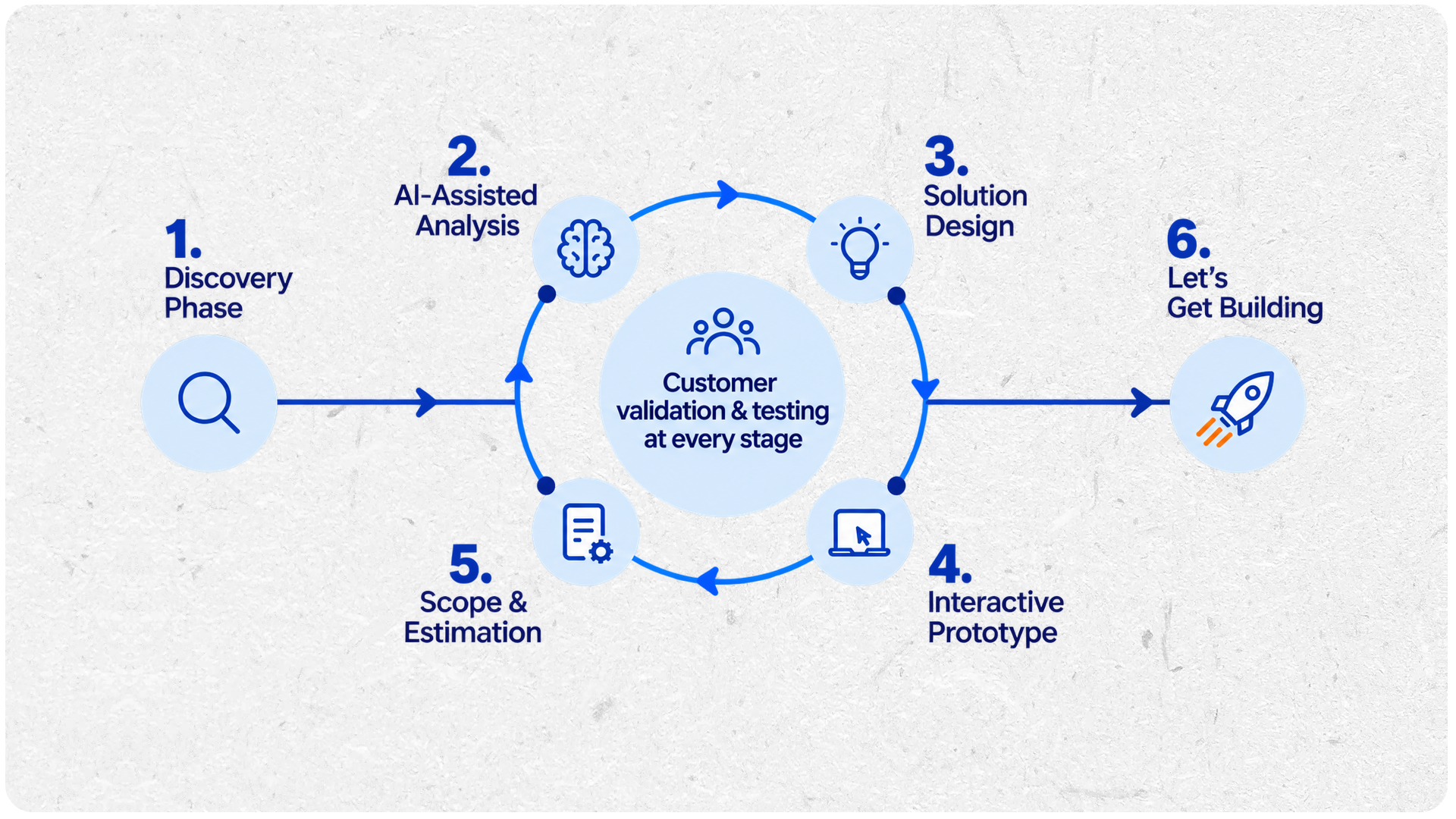
The process moves through six stages: discovery, analysis, solution design, prototyping, estimation and development. AI accelerates the repeatable work within each stage, while human expertise ensures the outputs are accurate, relevant and aligned with the organisation's goals. With Mendix as the development platform, the process is designed to move seamlessly from validated requirements and prototypes into application development.
Step 1: The Discovery Phase
In the initial discovery call, we explore business goals, users, painpoints, workflows and existing systems. An AI note-taker runs in the background, capturing everything, while any existing collateral, spreadsheets, prior BA/PO notes, etc., feeds straight into the picture. No context is lost. No insight goes unrecorded.
The output of this stage is an agreed problem statement and use case definition, a shared language that all three groups (business, IT, and delivery partner) can align around before the development begins.
Step 2: AI-Assisted Analysis
This is where AuraQ’s engagement model differs the most from traditional approaches. The output of the discovery call, transcripts, notes, and any supporting documentation the organisation provides, is fed into our AI tooling. Discovery outputs, transcripts, notes and supporting documentation are analysed and transformed into structured requirements, including user stories, workflows and supporting documentation. Work that could previously take weeks can be produced within hours. But speed isn't the objective on its own. Every output is reviewed by an AuraQ consultant and presented back to the client, where it can be challenged, refined and validated before moving forward.
Step 3: Solution Design
With the requirements agreed, the solution can be designed around the future-state processes, integrations, data flows and user experience. This stage is where IT teams and business stakeholders are brought into the same conversation, grounded in the same documented requirements. This brings business and IT teams into the same conversation, working from requirements they have already reviewed and agreed. The result is a clear solution blueprint that defines what will be built and how the different elements will work together, with the Mendix platform providing the foundation for the application architecture.
Step 4: Interactive Prototypes
The solution design is then brought to life through an interactive wireframe or proof of concept. Instead of reviewing requirements on a page, stakeholders can see the proposed application, navigate through it and provide feedback based on something tangible.
This is where assumptions are tested early. A stakeholder who previously agreed with a “streamlined approval workflow” can now see exactly how it works and identify what needs to change. Resolving that misunderstanding before development costs very little. Discovering it after development can mean weeks of rework.
That conversation, happening before development, costs almost nothing. The same conversation happening after development can cost weeks of rework. This is perhaps the most important stage in terms of risk reduction.
Step 5: Scope and Estimation
Because the prototype has been validated, the estimation that follows is grounded in something real. This is the stage at which organisations can make genuinely informed commercial decisions. They have seen the solution. They understand what is in scope and what has been deferred. The estimate they receive reflects actual complexity, not assumptions.
Step 6: Let’s Get Building
With approval in place, the project moves into development on the Mendix low-code platform. Because the business, IT and delivery teams have already worked through the requirements, design and prototype together, development starts with a shared understanding of the objectives, scope and expected outcome. Less time is spent clarifying requirements and resolving misunderstandings, allowing the team to focus on building and delivering value.
The Role of AI
AI accelerates the repeatable, low-risk parts of the engagement, the parts that benefit from speed and consistency but do not require meticulous business judgement. What AI does not do is make the judgment calls that define whether a project will succeed. It does not carry the 30 years of delivery experience that our consultants bring to every engagement.
Every AI output in our model is reviewed by a consultant before it reaches the client. Every stage that uses AI tooling is paired with human oversight. And every document, prototype, and design is presented back and refined together as many times as it takes before we move to the next step.
The Benefits: What Are We Actually Changing?
The result is a faster route from an initial idea to a validated, buildable solution, without removing the rigour needed to make a project successful.
Risk is reduced earlier. The gaps in requirements that traditionally surface in development are identified in the discovery and prototyping stages, where addressing the changes is relatively inexpensive. By the time development begins, the team is building something that has been reviewed, validated, and agreed by the people who will use it.
Alignment is built in. Business stakeholders, IT teams and the delivery partner work from the same requirements, designs and prototypes. Rather than relying on documents to bridge the gap between different perspectives, everyone has the opportunity to shape and validate the solution together.
Time to MVP is shortened. By compressing the work that happens before development, organisations can move from an initial idea to a validated, buildable solution much faster than through a traditional discovery process. That means development can start sooner and working software can be delivered faster.
This is perfect for organisations moving quickly.
This approach is particularly valuable for organisations that need to move quickly, whether they are modernising legacy processes, responding to competitive pressure or looking to demonstrate ROI from a technology investment within a defined timeframe. They don't need less discovery. They need better discovery that delivers more, faster.
Low-code development on the Mendix platform already compresses build timelines significantly. AuraQ's AI-assisted engagement model addresses the phase that comes before it, reducing the time spent translating ideas into requirements, designs and validated prototypes.
Together, they create a faster, more connected path from initial conversation to working MVP, while keeping the human expertise, governance and validation needed to deliver software that actually works for the organisation.
AuraQ combines AI-assisted delivery with 30+ years of software development experience to help organisations move from idea to build-ready solution faster. By combining AI where it accelerates the process, human expertise where judgement matters, and the Mendix platform to turn validated designs into applications, we help organisations reduce risk, improve collaboration and get to value sooner.
The goal isn't to replace planning with AI. It's to make planning faster, more tangible and more useful so that planning leads to building.
More from Knowledge Hub
Continue exploring insights and strategies